


Multi-node inhibition:overcoming the complexityof a major cancer pathway.
Single node inhibitors of the PAM pathway are approved for the treatment of certain cancers, but their class toxicities have constrained adoption.
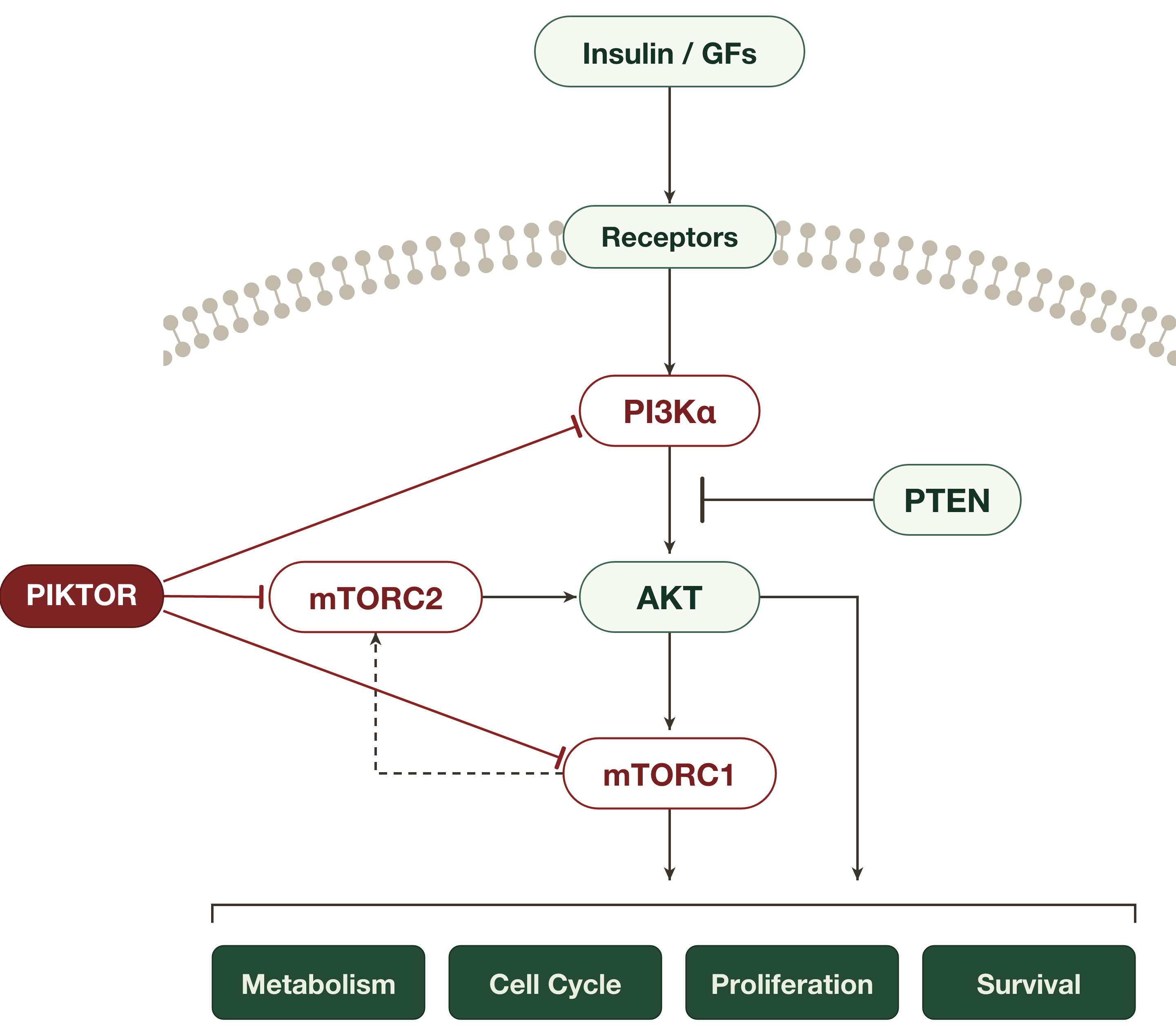
PIKTOR takes a different approach: by targeting multiple nodes simultaneously, each component is designed to be administered at substantially lower doses than are required for monotherapy — with the potential for deeper, more durable suppression within a more tolerable clinical profile.
THE SOLUTION
Vertical pathwayblockade with PIKTOR.
PIKTOR is a proprietary, investigational, all-oral combination of serabelisib (a selective PI3Kα inhibitor) and sapanisertib (an ATP competitive dual mTORC1/2 inhibitor). Together, they aim to achieve vertical multi-node pathway blockade — targeting 'upstream' and 'downstream' pathway nodes simultaneously, addressing oncogenic activation and the adaptive escape routes tumors engage to resist treatment.
By targeting multiple nodes simultaneously, PIKTOR is designed to be administered at substantially lower doses of each drug than are required when used as monotherapy — which we believe may translate into improved efficacy with improved tolerability.
We believe serabelisib's selectivity for PI3Kα over other PI3K isoforms may reduce the risk of off-target toxicities associated with broader Pan-PI3K isoform inhibition.
THE CHALLENGE
The mostaltered pathway in cancer
The PAM (PI3K/AKT/mTOR) pathway is a critical signaling network that regulates cell growth, survival, and metabolism. It is one of the most frequently altered oncogenic signaling pathways in human cancer, with greater than 60% of certain tumor types, including HR+ breast and endometrial cancer, showing pathway alterations (Sanchez-Vega et al., Cell 2018, Zhang et al., Cancer Cell 2017; Martini et al., Front Oncol 2014).
Despite this clinical need, approved therapies targeting this pathway have produced limited clinical benefits, often accompanied by toxicities that have constrained their utilization.
Clinical evidence suggests that single-node inhibition itself creates selective pressure that drives tumors to acquire additional pathway mutations, contributing to treatment resistance (Juric et. al., 2015, Coleman et. al., 2021, Varkaris et. al., 2024).
There is also substantial evidence that the PAM pathway plays a central role in the resistance of tumors to a wide range of treatments (including targeted and chemotherapies), even without the presence of pathway mutations (reviewed by Dong et. al., 2021) extending the potential clinical utility to tumors that are PAM 'wild-type'.
OUR NUMBERS
Clinical data fromPhase 1b Results.
In an investigator-initiated, single-center, open-label Phase 1b study (n=19 enrolled; n=15 response-evaluable) of patients with advanced endometrial, breast, and ovarian cancer who had, on average, received 4 prior lines of therapy
Overall Response Rate (including 3 complete responses)
ORR in PAM Pathway-Altered Patients (5 of 7 patients)
Median Progression-Free Survival
PIPELINE
Three programsBuilt where the science led.
PROGRAM / MECHANISM
INDICATION
STATUS
PROGRESS
Investigational drug products. Not approved by the FDA or any other regulatory authority.
PUBLICATIONS
The science ison the record.
FAETH